
 “No Kings” march down Main St., in Lexington, Kentucky, on Saturday, March 28, 2026. Sydney Novack/The Watchdog
Thousands of people protested at the Robert F. Stephens Courthouse Plaza as part of the third nationwide “No Kings” rally to speak out against the Trump administration’s actions.
Organized by several community organizations on Saturday, March 28, the No Kings protest saw attendees advocate against several measures including conflict in Iran and immigration enforcement.
Many organizations, such as Peaceful Bluegrass Resistance, Lexington-Fayette NAACP and the League of Women Voters of Lexington set up booths for people to learn more about each group’s mission, all rooted in social justice and advocacy.
Craig Blair, the founder of Peaceful Bluegrass Resistance, said the protest is meant to show that no one is above accountability, even the President of the United States.
“We don’t have the platform that our Republican legislators do, and so for them to stand at the podium and say, ‘What we are doing is the will of the American people,” Blair said, “you know, I take days like this as my opportunity to stand up and say, ‘No, this is not the will of the American people.’”
Securing democracy and constitutional rights is critical, according to Blair, who said the pillars of democracy seem to have “fallen by the wayside.”
Blair said he did not understand how people can live with such hatred, and that seeing others be demeaned also served as a push for Blair to become more involved in social advocacy.
“They’re gleeful in the way that they’re dehumanizing people, and then they’re selling merchandise for Alligator Alcatraz, and I just can’t accept that that’s the heart of America,” Blair said. “That’s not the spirit of America, that type of hatred.”
 Thousands of people march down Vine Street during the “No Kings” protest in Lexington, Kentucky, on Saturday, March 28, 2026. Christian Kantosky/The Watchdog
“Alligator Alcatraz” refers to an immigration detention center in the Florida Everglades that has been the center of controversy over living conditions, according to the Associated Press.
Certain rhetoric regarding inequality also concerned attendee Diane Payne, a retired Sayre School administrative assistant, who said President Donald Trump was not supportive of all people.
“He’s just not for everyone. He’s for the billionaires, you know, those who are supposedly best,” Payne said. “It’s the way he comes across. It’s nothing positive, always belittling.”
Payne highlighted Trump’s history before he was president, pointing to his alleged past restrictions on renting his buildings to Black people in New York City.
The Department of Justice sued Trump, his father and Trump Management in 1973 for alleged racial discrimination, according to National Public Radio. The case was settled after two years with no admission of guilt, following Trump’s efforts to countersue the Justice Department for making false statements.
As president, Payne said Trump has also fought against immigration rights and targeted voting policies.
“He just wants this control, and that’s not what our democracy is,” Payne said. “It’s not ‘King,’ you know, you can’t be king. It’s [democracy] for all people.”
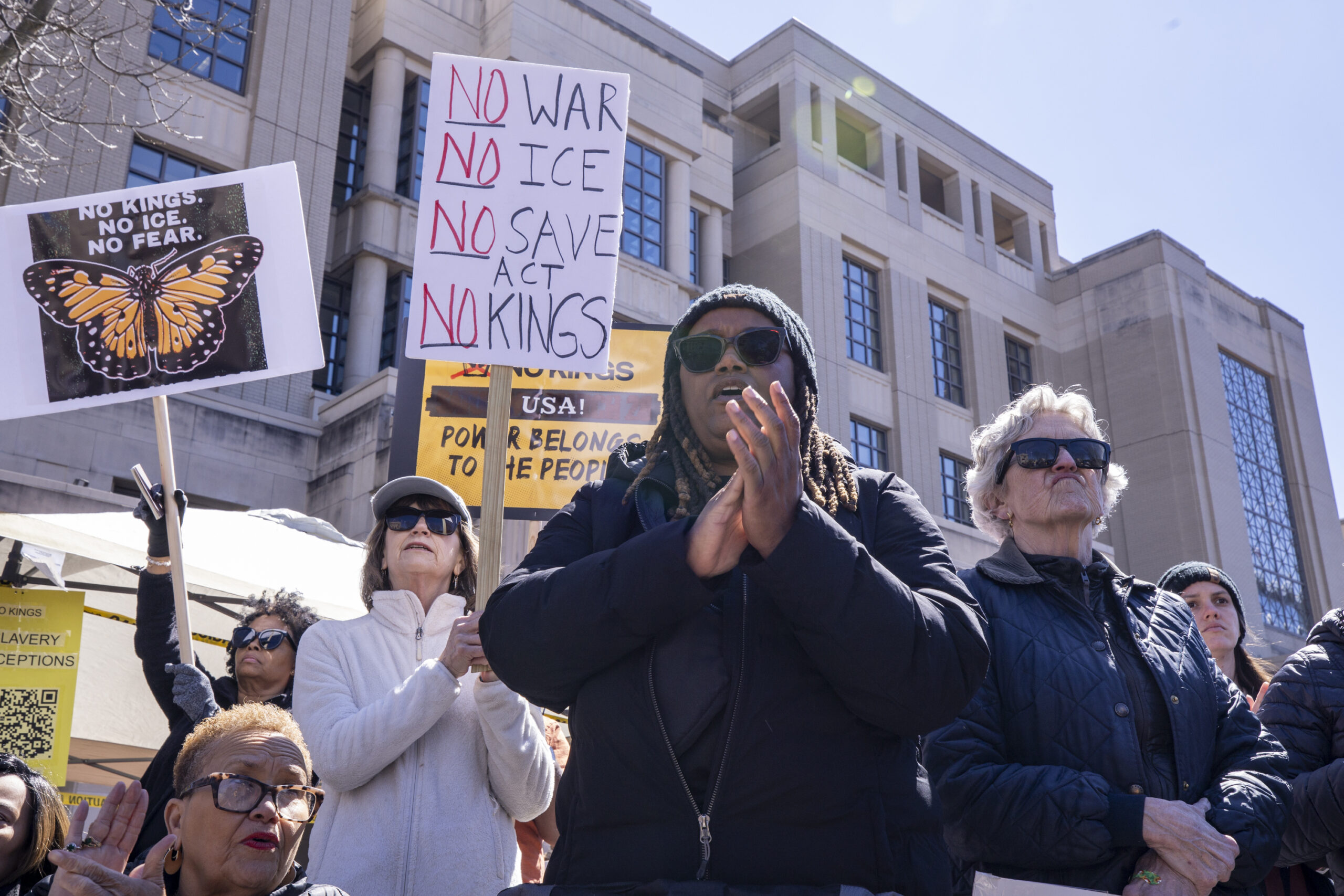 Kim Pennington, center, claps during the “No Kings” protest at the Robert F. Stephens Courthouse in Lexington, Kentucky, on Saturday, March 28, 2026. Christian Kantosky/The Watchdog
Fellow attendee Rose Thiedich said she has attended No Kings protests in both Lexington and Frankfort, having attended demonstrations against the Vietnam War in the past.
The United States’ conflict in Iran was a key reason as to why Rose attended the most recent No Kings protest. She said it saddened her to see people be killed as a result of the conflict.
“We need to quit hurting innocent people,” Rose said. “If the leaders of the countries want to fight, then let them fight, and leave innocent people out of it.”
Rose’s son, Eric, who attended the protest with her, explained how the conflict in Iran can reflect the Trump administration’s priorities on a domestic level.
“If we can have the money to fund war in the Middle East, you know, we should be able to fund those things to help our citizens here and social safety nets or universal health care and things like that,” Eric said.
A more holistic change is needed, according to Eric, because many issues are intertwined.
If the nation’s leaders are unwilling to advocate for others’ interests abroad, Eric said the public could not expect leaders to fight for Americans’ interests either.
“If our leaders can’t stand up for genocide in the Middle East,” Eric said, “how can we expect them to stand up for our rights here?”
Leave a Reply