
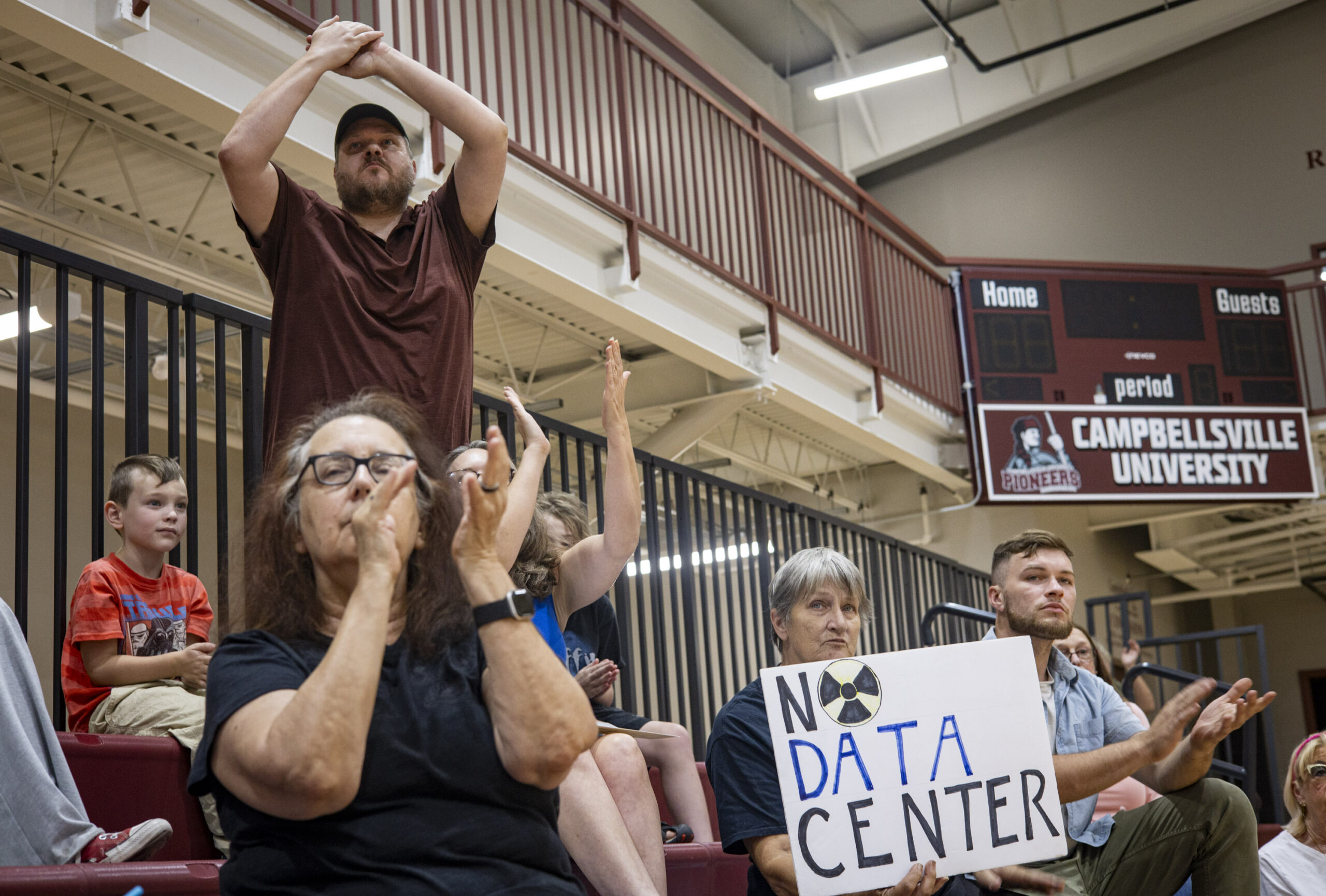
 People clap after listening to a speaker during a Mercer County Joint Planning and Zoning Commission special-called meeting at the Campbellsville University Harrodsburg Athletic Center in Harrodsburg, Kentucky, on Thursday, July 23, 2026. Isabella Sepahban/The Watchdog
The Mercer County Joint Planning and Zoning Commission held a special-called meeting to consider revised text amendments to an ordinance that would allow for data centers in the area.
Mercer County residents voiced their thoughts on the ordinance during public comment on Thursday, July 23, at the Campbellsville University Harrodsburg Athletic Center.
Days later, on Tuesday, July 28, the Mercer County Fiscal Court approved the first reading of a data center moratorium, pausing the acceptance, processing and approval of any applications for a zoning map amendment, conditional use permit, subdivision plat or building or construction permit for a data center within unincorporated Mercer County.
Mercer Co. Fiscal Court moves forward with moratorium
The Fiscal Court’s proposed moratorium ordinance classifies data centers as a facility designed or primarily used to house computer servers, storage systems or other specialized computing hardware for the storage, processing, transmission or distribution of data.
The ordinance’s definition of data centers also addresses cooling, power and back-up generation infrastructure.
“Examples include facilities used for cryptocurrency mining (including bitcoin mining), artificial intelligence training or processing, and cloud computing,” the moratorium reads.
If passed, the moratorium would remain in effect for 12 months upon passing, or until the Fiscal Court adopts permanent data center regulations.
Pending applications would not be impacted, as the ordinance says it does not apply to any application for a data center that was complete and accepted for filing by the applicable reviewing authority.
Bethany Corea, a resident of Burgin, raised concerns about the duration section of the proposed ordinance that allows for the moratorium to be lifted before the 12-month mark if the Fiscal Court adopts permanent data center regulations.
The Mercer County Joint Planning and Zoning Commission has been considering an ordinance that would regulate data centers in the area. If the commission votes to move forward with the ordinance, then they would send it to the Fiscal Court for approval.
“We just had the second public hearing, that they’re allegedly at the meeting Thursday going to vote on, so you tell me which is going to happen first,” Corea said. “This paper essentially does nothing other than for them to say, ‘Look, we did what you wanted. We did a moratorium,’ but they listened to zero of the concerns of the citizens.”
According to Corea, the purpose of a moratorium is to give the Mercer County Joint Planning and Zoning Commission “a pause” so they can have more time to write a “responsible and informed ordinance.”
“The moratorium is to give planning and zoning more time,” Corea said, “not to just cover this little bit of time that may occur in between.”
 People react after being asked to raise their hands if they do not want a data center in Mercer County during a Mercer County Joint Planning and Zoning Commission special-called meeting at the Campbellsville University Harrodsburg Athletic Center in Harrodsburg, Kentucky, on Thursday, July 23, 2026. Isabella Sepahban/The Watchdog
Mercer Co. Joint Planning and Zoning Commission continues considering regulation
The ordinance under consideration would create industrial technology zones in Mercer County in which data centers would be permitted.
Although Hank Graddy, an attorney representing the “We Are Mercer County” organization, said the revised ordinance was a “very helpful second step,” he addressed other concerns not included in the second draft.
The ordinance seeks to establish suitable locations and comprehensive minimum standards for the siting, construction and operation of data centers in compliance with the county’s Comprehensive Plan, which includes encouraging the preservation of “prime farmlands.”
“In spite of that opening assertion, the reference to the comprehensive plan, I do not believe this ordinance accomplishes those goals,” Graddy said.
Pointing to the ordinance’s restriction that campuses in IT zones can only take up 1,500 acres, Graddy said the section provides a figure with no foundation for the acreage cap.
The ordinance’s section regarding a 1.5 mile radius circle where IT district campuses would be located also provides an arbitrary number, according to Graddy.
“These two features, the good and the bad, are both vulnerable to being attacked because there is no research basis for those sections,” Graddy said.
The second draft of the ordinance also included a section requiring data center projects over 100 megawatts to create an account of $50 million, which would earn interest to fund employing engineering and inspector expertise, according to Graddy.
However, Graddy said he was “perplexed” about what the section would mean for data centers under 100 megawatts.
“It tells that this money is available if it’s over 100 megawatts,” Graddy said. “But, I see it looks like you’ve omitted spelling out how much smaller facilities would be expected to pay to contribute for engineering help.”
Instead of moving forward with the text amendment process, Graddy said the commission should begin updating the Comprehensive Plan so it could address where data centers should go, how big they should be and whether or not hyperscale data centers should be allowed at all.
Graddy asked that the commission support a moratorium to give more time for certain processes, such as amending the Comprehensive Plan and addressing bringing the unincorporated city of Burgin back into the planning and zoning commission process.
According to Graddy, the Mercer County Fiscal Court has begun the process of considering a moratorium. He cited other areas that have adopted moratoriums, including Fayette County and Oldham County.
“I would urge you to consider taking the steps to protect the people of Mercer County, as the leadership in Woodford County and Fayette County are protecting those residents,” Graddy said.
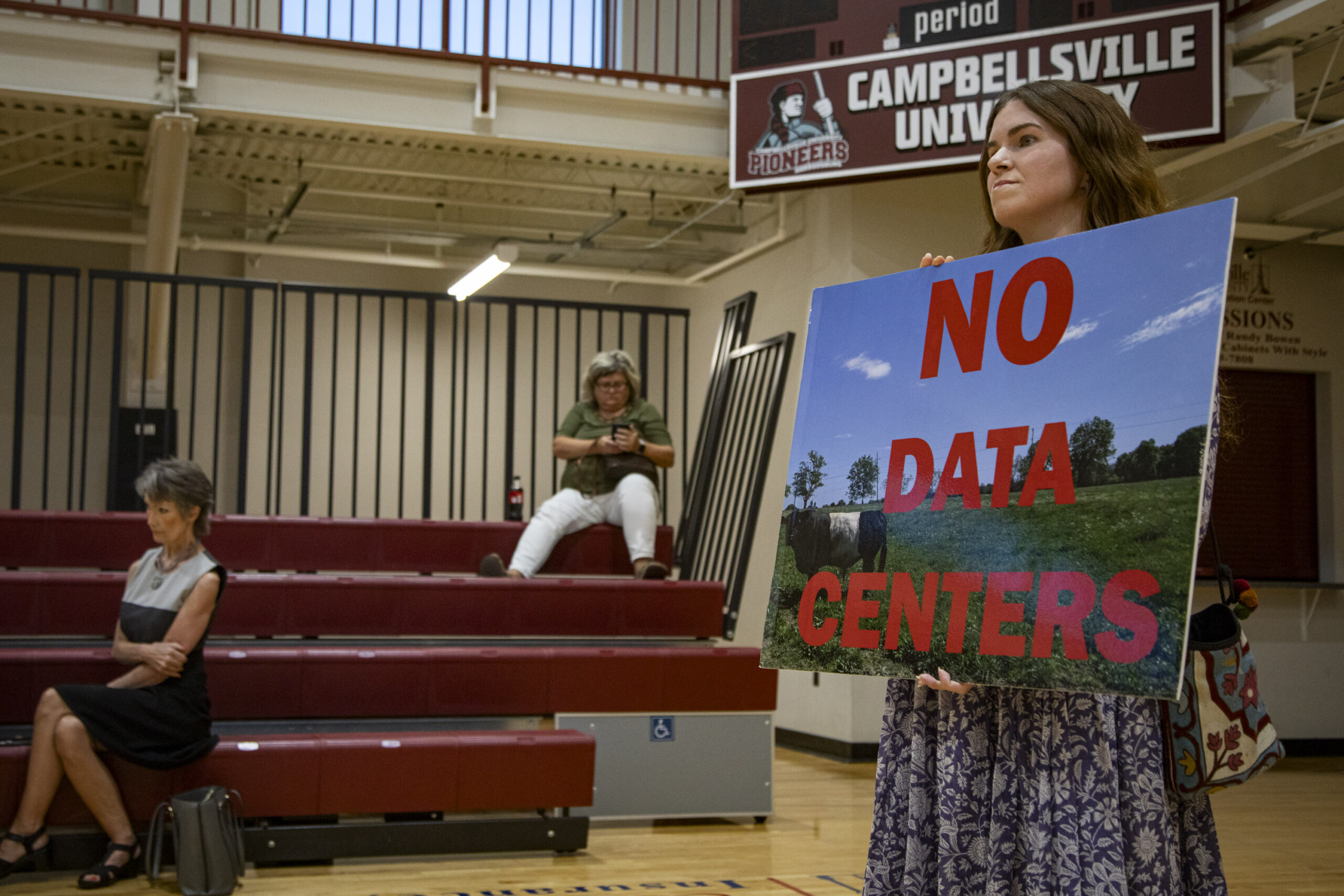 A woman holds a sign in front of Kentucky State Representative Kim King, far left, during a Mercer County Joint Planning and Zoning Commission special-called meeting at the Campbellsville University Harrodsburg Athletic Center in Harrodsburg, Kentucky, on Thursday, July 23, 2026. Isabella Sepahban/The Watchdog
Henry Smith, counsel for the Mercer County Joint Planning and Zoning Commission, said if a moratorium prohibiting data center development for a certain period of time were to pass, the commission could continue working on regulations for such developments.
“I think it’s contemplated that the work of drafting continues,” Smith said. “And so until this body is told otherwise, we’re doing the work of drafting this thing and trying to have a regular regulation in place.”
The Mercer County Fiscal Court can also refuse the commission’s recommendation on the ordinance, according to Smith.
“Any text amendments that we (the commission) do, they (the Fiscal Court) have to approve,” Smith said. “Any zone map amendments that we do, they have to approve.”
Smith addressed concerns regarding the Comprehensive Plan. He said he did not find any statue requiring the Comprehensive Plan to mention “every single use” in a proposed zoning ordinance.
Harrodsburg resident Karen Hughes said the county should implement a moratorium “so that we can get this right,” saying she believed developers should be issued conditional use permits that would allow the county to shut developments down if they violate regulations.
“I feel like this should be a conditional use permit, just because you can have more public involvement. Clearly we want to be involved,” Hughes said. “We want to be heard, there can be more meetings, there can be more time for review.”
Preserving the area’s history and tourism was also a concern for Hughes, who said the 1.5 mile radius puts a data center “practically at the front gate of Shaker Village.”
Shaker Village of Pleasant Hill is the largest National Historic Landmark in Kentucky and home to 34 original Shaker structures and the country’s largest private collection of original 19th century buildings.
CEO and President of Shaker Village Billy Rankin spoke during the meeting, highlighting the value of the landmark to Mercer County’s history, tourism industry, natural resources and agriculture.
At a previous commission meeting, Rankin said he joined other community members in recommending a moratorium until the Comprehensive Plan could be updated, as well as a feasibility study for data center development.
“I am sorry to see that my comments and those of others made little impact on the approach that you took to this process,” Rankin said. “Industrial development is always a complicated issue for rural communities, but especially when the industry in question is new and the full impact of its existence is still hard to fathom.”
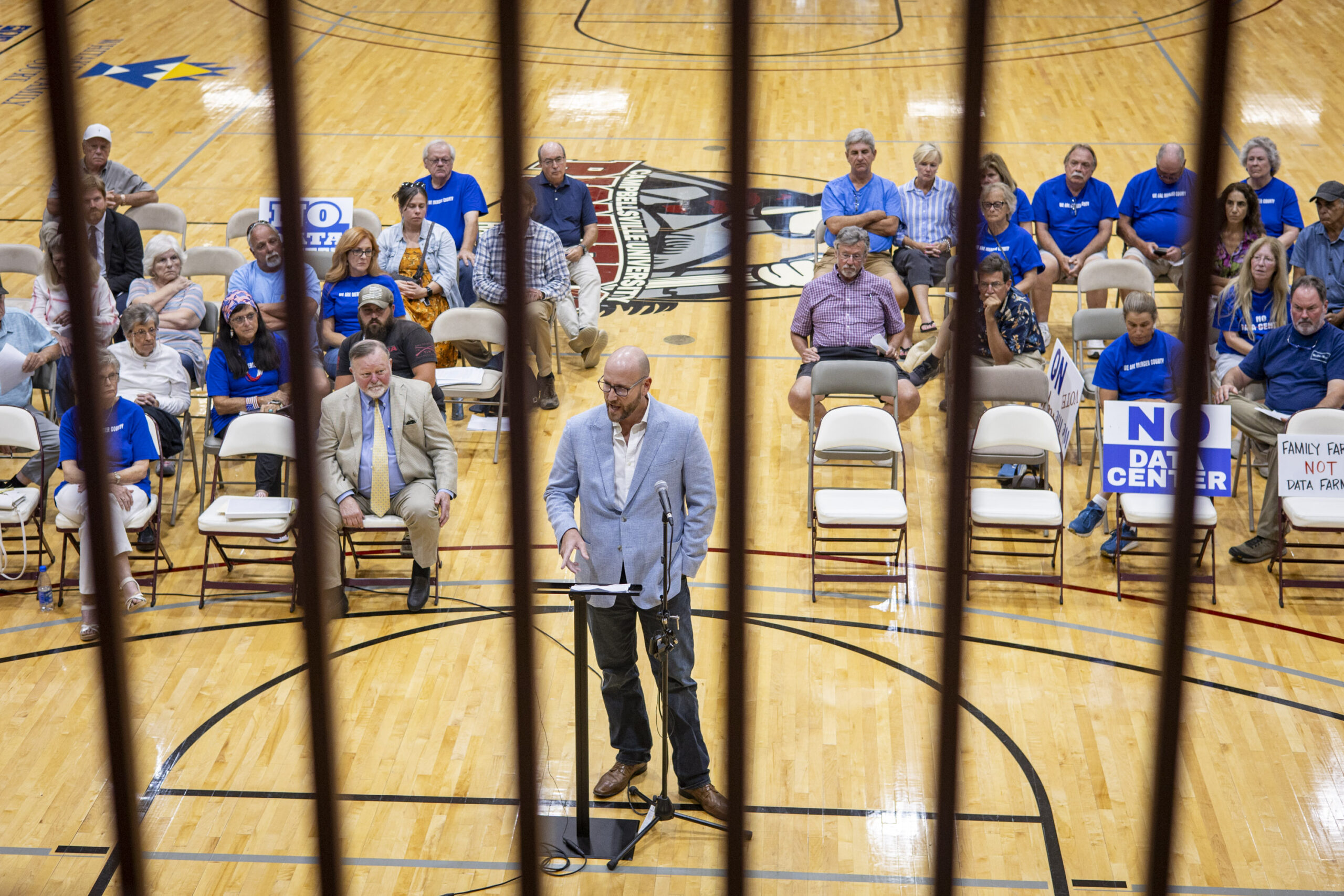 CEO and President of Shaker Village of Pleasant Hill Billy Rankin speaks during a Mercer County Joint Planning and Zoning Commission special-called meeting at the Campbellsville University Harrodsburg Athletic Center in Harrodsburg, Kentucky, on Thursday, July 23, 2026. Shaker Village is the largest National Historic Landmark in Kentucky and home to 34 original Shaker structures and the country’s largest private collection of original 19th century buildings. Isabella Sepahban/The Watchdog
In an effort to learn more about data centers, Rankin said he set up private meetings with the senior vice president of a data center developer, the general contractor and executives from the company that would be the ones to build a data center in Mercer County, and Brian Luftman, the founder of American Farm Investors.
Luftman, a Fayette County resident, owns land in Mercer County and said he allowed data center developers to submit offers on his land.
“Let me tell you what I’ve learned: We’re a perfect target,” Rankin said. “Our land is relatively inexpensive, we’re close to the energy and the water that they need, but most importantly, we’re in a community that’s eager to find revenue, and we’re soft on our protections.”
The “best scenario” for data center developers, according to Rankin, is that they come into an area without a planning and zoning commission, which he said was what was being attempted in Burgin.
The Burgin City Council had attempted to annex land tied to a proposed data center development during a meeting on July 9, however, a scheduled second reading of the ordinance was called off after the city said the first reading did not officially occur.
The next “best scenario” for developers is for an area to “rush into” an ordinance, according to Rankin.
“We aren’t examining, we aren’t studying. We’re rushing to a predetermined end based on promises,” Rankin said. “And in that rush, you will not only cause more harm to our land and our people, but you won’t even get the most out of the developers in return. It’s not too late to do this the right way.”
The Mercer County Joint Planning and Zoning Commission adjourned Thursday’s meeting, which is scheduled to continue Thursday, July 30, at 5 p.m. at the Campbellsville University Harrodsburg Athletic Center.
Leave a Reply