
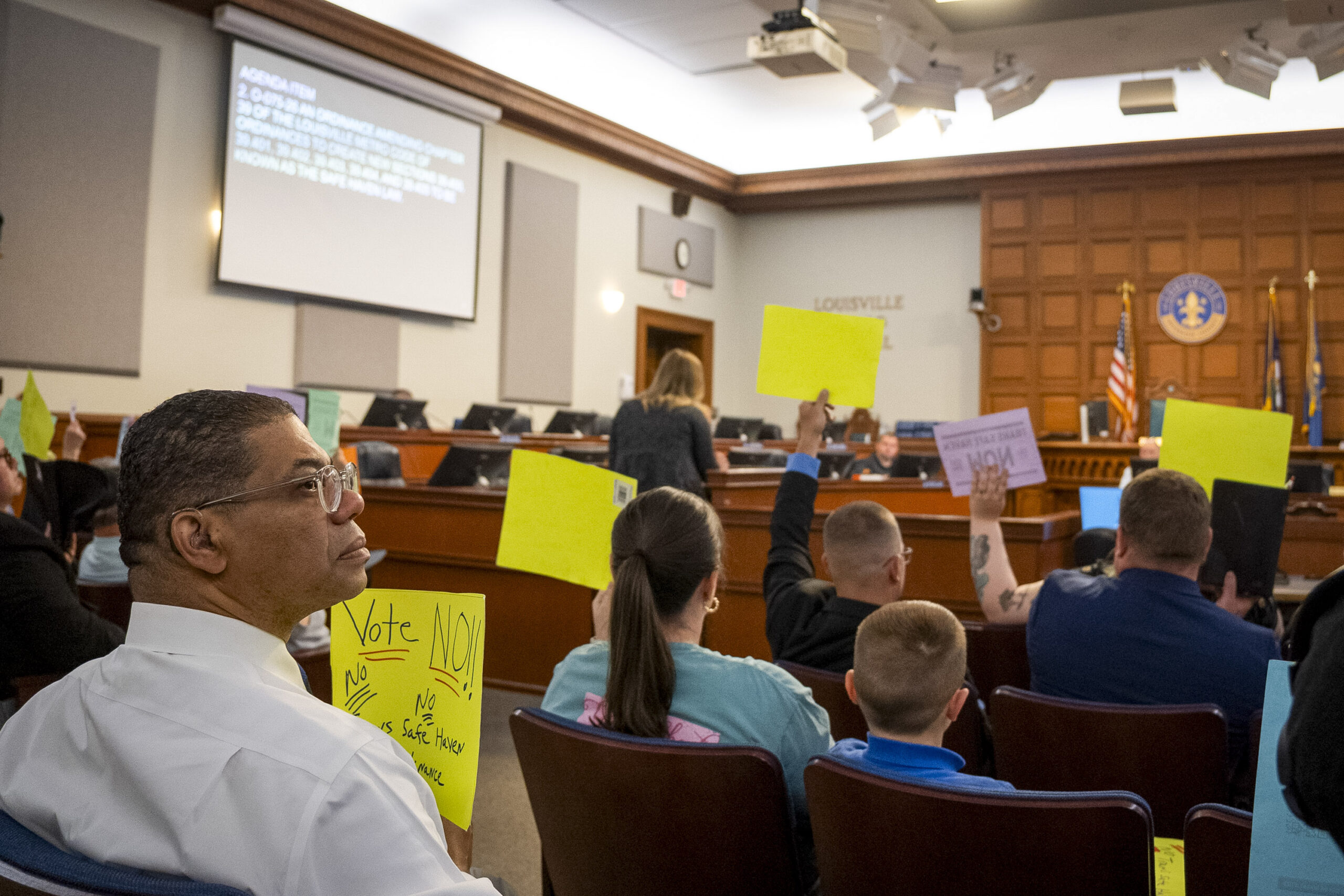
 Metro Council Committee members vote on the Trans Safe Haven Ordinance whilst protestors and counter-protestors hold signs at the Metro Council Public Safety Meeting in City Hall, Louisville, Kentucky, on June 3, 2026. Peyton Tindall/The Watchdog
Louisville’s Metro Council Public Safety Committee voted six to one against the Safe Haven Law, an ordinance written to create certain protections for transgender people.
The legislation aimed to amend Chapter 39 of the Louisville Metro Ordinances to designate the city as a “safe haven” for transgender people.
The ordinance, co-sponsored by Metro Councilpeople JP Lyninger and Shameka Parrish-Wright, focused on committing Louisville to providing “equal protection of transgender and gender non-conforming people,” and naming Louisville as a safe haven for trans people.
The ordinance sought to prevent trans people and doctors from being detained for “seeking or providing gender-affirming healthcare,” restricting trans people from the use of public and social services and prohibiting “performers wearing non-stereotypical dress or costume based upon the entertainer’s actual or perceived gender.”
It would also require training for Metro Government employees and disciplinary action against those who violate the Safe Haven Law.
Lyninger introduced the bill by saying trans people nationwide are being persecuted under the current federal administration. He pointed to Tennessee Gov. Bill Lee’s designation of June as Nuclear Family Month instead of Pride Month.
“My trans friends, my trans family, loved ones, coworkers are under attack,” Lyninger said. “These attacks are emboldened on queer people generally, because we have retreated from protection and full support of trans people. They’ve come for trans people first, and too many said that’s an acceptable loss. It’s not an acceptable loss to me.”
The Safe Haven Law received support from 34 organizations, 35 local businesses and 3,262 people in Louisville, according to Lyninger.
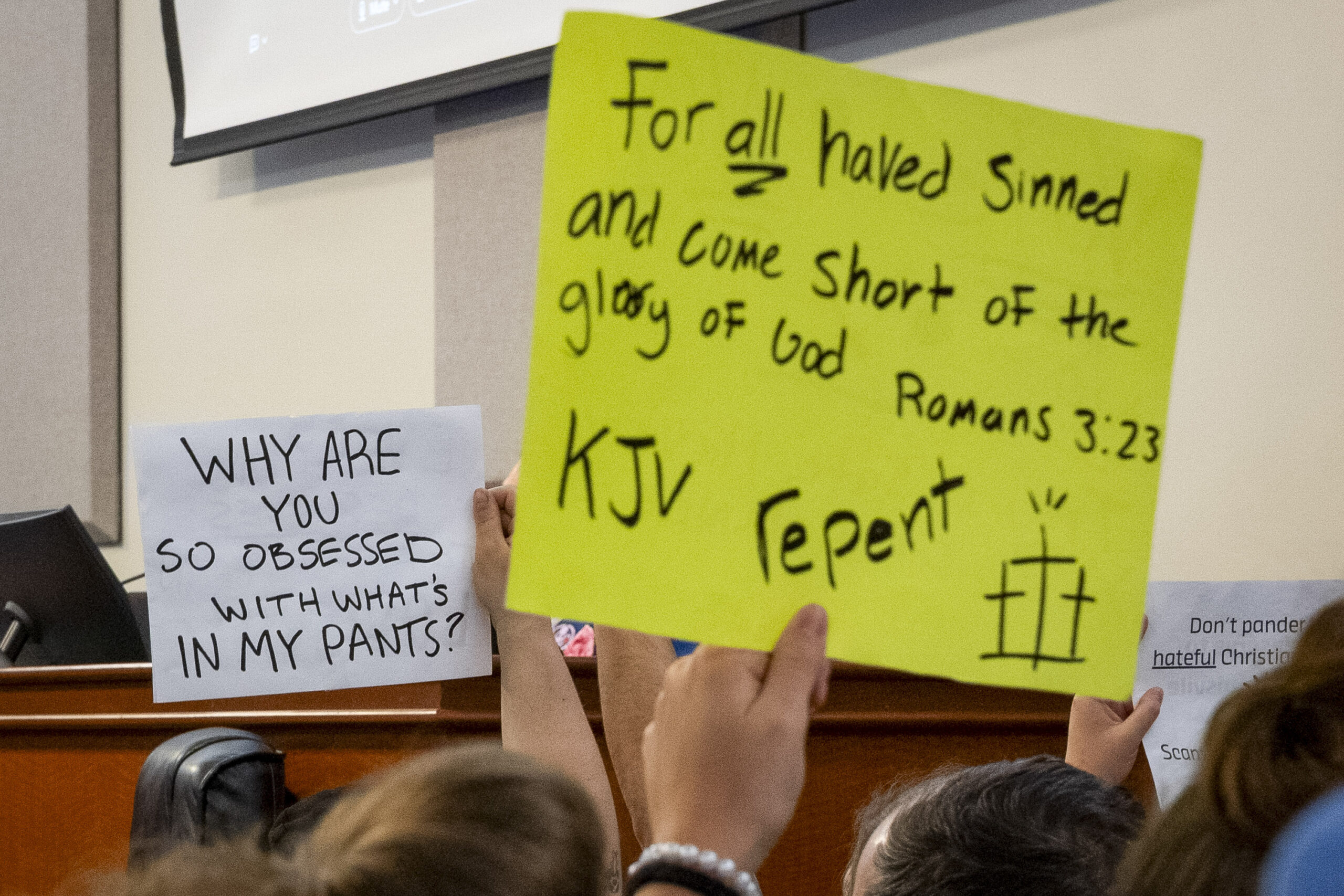 Metro Council Committee members vote on the Trans Safe Haven Ordinance whilst protestors and counter-protestors hold signs at the Metro Council Public Safety Meeting in City Hall, Louisville, Kentucky on June 3, 2026. Peyton Tindall/The Watchdog
Elizabeth Harden, a trans woman and resident of District 24, which encompasses the Hollow Creek and Spring Mill neighborhoods, spoke in support of the bill. She asked the council a question she promised was “not rhetorical.”
“If this ordinance fails, what are you going to do to make sure the city is safe for your trans constituents?” Harden asked.
She also spoke about the bill’s importance as a signifier of trans people’s safety in Louisville and said the potential downside of the bill was very low.
“I think everyone in this room is well aware that the Republican supermajority in Frankfort salivates at every available opportunity to undermine the city of Louisville and restrict the freedoms of LGBTQ Kentuckians,” Harden said. “But if the 2026 legislative session is any indication, Frankfort hardly needs to be provoked to do either of these things.”
Many people at the meeting raised concerns about the ordinance, including some who said they worried the bill did not provide adequate protection for trans people of color and that the law would lead to retaliation from state government officials.
Others said they held a moral opposition to certain protections being afforded to trans people and held signs advocating against the ordinance on religious grounds.
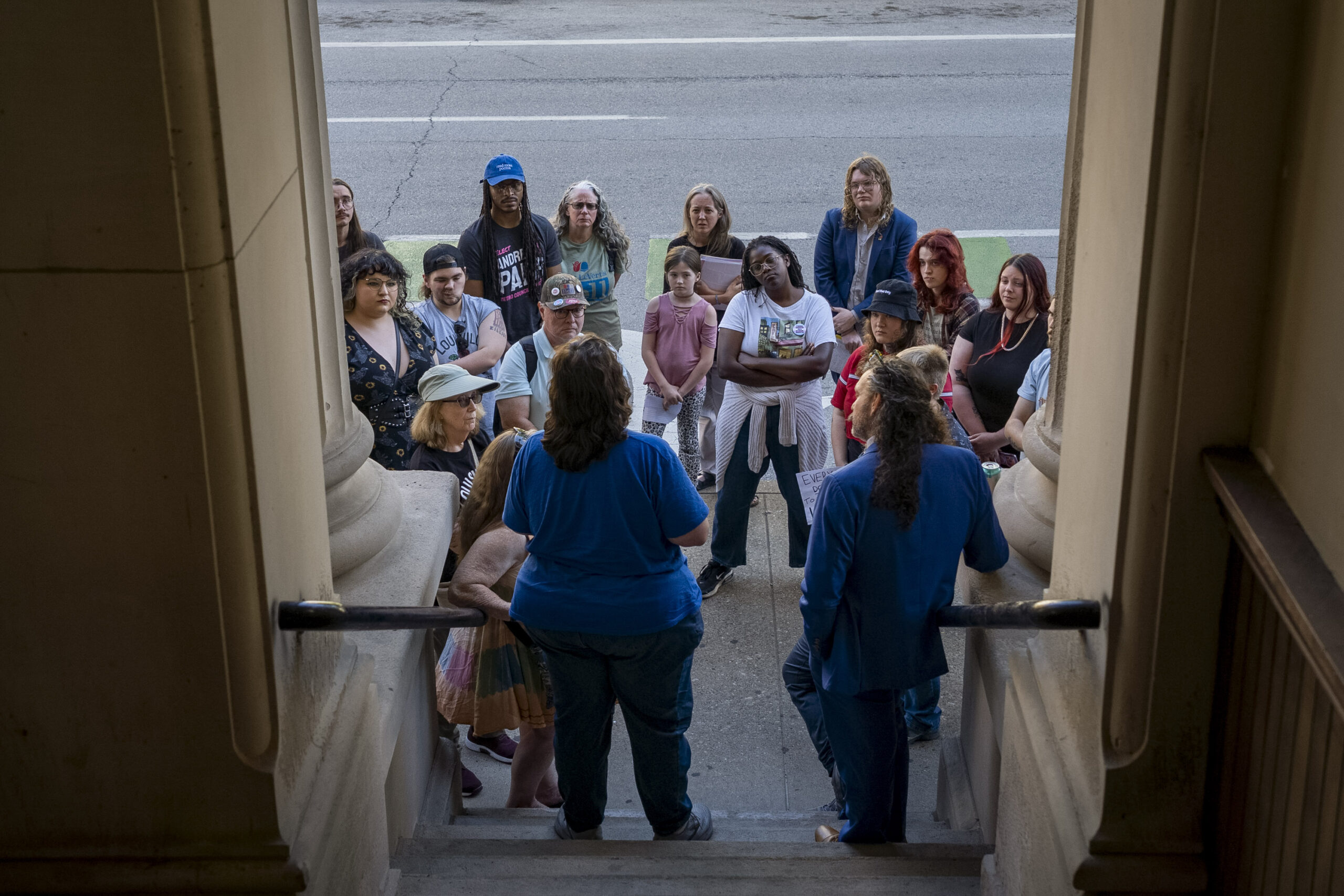 Members of the Democratic Socialists of America meet outside City Hall after the Trans Safe Haven Ordinance fails to pass at the Metro Council Public Safety Meeting in City Hall, Louisville, Kentucky on June 3, 2026. Peyton Tindall/The Watchdog
Jaz Williams, a trans man and the Trans Health Director for the Kentucky Health Justice Network, spoke against the bill.
“We are concerned by the lack of research, clearly defined terms and enforcement mechanisms that have gone into the ordinance,” Williams said.
He also raised concerns that the bill did not adequately represent trans people of color. Williams told the Council he had heard from several trans people of color who felt the bill overlooked parts of the city, such as the West End.
“We are also concerned that the ordinance fails to address the current needs of trans Kentuckians, not just future possible protections that might come our way,” Williams said. “UofL students are losing their gender affirming care, the treatment of our trans youth in JCPS – these are current issues that could help people’s lives today.”
Concerns that the bill was not ready were echoed by others, such as Bobbie Glass, a professor at the University of the Cumberlands, retired public school teacher, chair of the Fairness Education Fund and trans woman.
Glass said she worried the bill was too focused on potential threats to trans people and not current threats.
“We recognize that what happens in Louisville does not stay in Louisville,” Glass said. “Decisions made here can have consequences for LGBTQ people living in smaller communities and rural parts of our state that do not have the same visibility, infrastructure or local protections that we do.”
Backlash from the state legislature was also a concern for critics, saying the bill would cause state politicians to further attack trans people through legislation.
The Safe Haven Law will now go to the full council on Thursday, June 11, under old business with an unfavorable recommendation.
Leave a Reply