
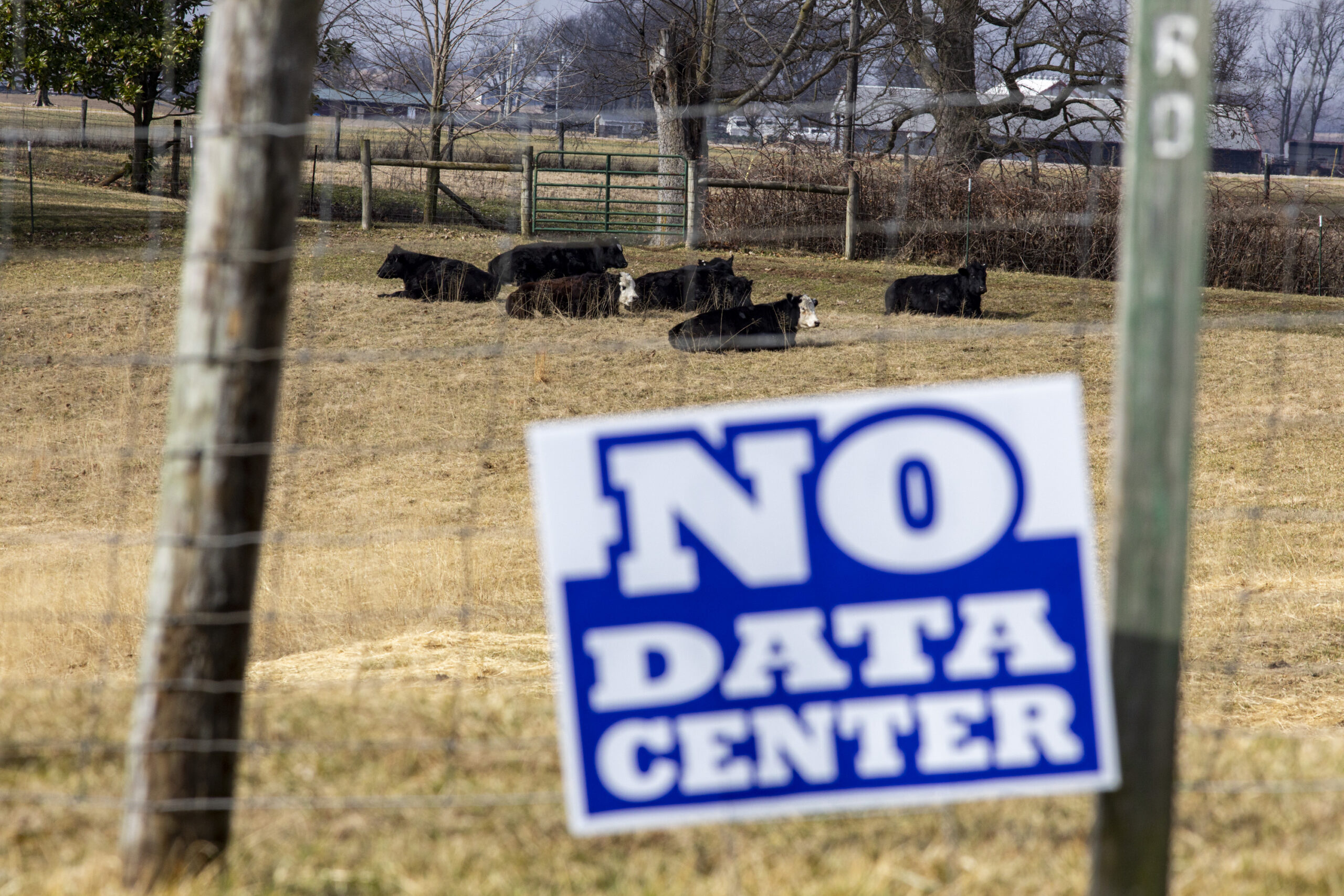
 Cows graze in a field which sits a 0.5 mile from the site of the proposed data center in Burgin, Kentucky, on Monday, Feb. 16, 2026. Christian Kantosky/The Watchdog
HARRODSBURG, Ky. — Mercer County residents advocated against a proposed data center that would be built on “prime farmland” in Harrodsburg during a planning and zoning commission meeting.
Held on Wednesday, Feb. 18 at The Stable at the county’s Fair Grounds, the Mercer County Joint Planning and Zoning Commission meeting saw high attendance, with over 200 people standing around the room after residents filled every seat.
Members of We Are Mercer County, a group focused on civic engagement and informed discussion about issues in the community, as well as others in the community spoke about potential impacts the data center could have on the county’s agricultural operations, people’s wellbeing and resource consumption during over three hours of public comment.
Sean Perryman has lived in Mercer County since 2020, teaching computer science at Campbellsville University.
Before teaching in Mercer County, Perryman worked for a web hosting company, leading him to interact with data centers firsthand.
Due to his experience, We Are Mercer County, asked Perryman to be an “expert witness,” of sorts, he said.
A concern shared by Perryman and other community members at the meeting was the noise data centers can produce.
“When you’re driving up to it two miles away, if you roll your windows down in the car, you can hear it already,” Perryman said. “They’re extremely loud, and it’s constant, you know, it’s basically a constant hum that never stops.”
 A planning and zoning commission meeting at the Mercer County Fairgrounds in Harrodsburg, Kentucky, on Wednesday, Feb. 18, 2026. Sydney Novack/The Watchdog
Such noise can impact livestock, according to Caitlyn Cooper, the co–owner of Desmar Stables in Mercer County.
During public comment, Cooper said responsible horsemanship would demand her stable’s operations to move out of the area since horses rely on their sense of sound and predictable environmental patterns.
“For animals whose survival instinct is tied directly to sound, these noises will not only affect my horses, they will affect all the animals and wildlife as well as the humans who care for them,” Cooper said.
Desmar Stables would be located right across the street from the proposed data center, according to Cooper.
“Industrial data centers and performance horse farms are not compatible neighbors,” Cooper said.
It’s not just the health of animals, but also the health of people living in Mercer County, that has raised concern among residents such as Dr. Rick Angel.
Angel spoke about these health risks during the meeting and said a major concern was the persistence of noise, specifically low-frequency noise, as opposed to loudness.
Traveling much farther than regular noise, low-frequency noise, according to Angel, can penetrate through walls and windows. He said guidelines about data center noise do not target low-frequency noise, instead focusing on whether hearing is impacted.
“The result is often the developers will apparently say ‘well we’re gonna put a buffer’ or ‘we’re gonna put these little things on the roof,’ like he talked about, that will decrease the noise,” Angel said. “Well, none of those are effective against low-frequency noise.”
Low-frequency noise can cause sleep disturbance, Angel said, which in turn can lead to hypertension, immune dysfunction and cardiovascular strain. This type of noise can also contribute to mental health problems and difficulties concentrating, he said.
 A Facebook group chat message is seen while Brian Luftman, one of the few pro-data center speakers, talks during a planning and zoning commission meeting at the Mercer County Fairgrounds in Harrodsburg, Kentucky, on Wednesday, Feb. 18, 2026. Christian Kantosky/The Watchdog
Apart from health effects, some Mercer County residents, including Kim Yeast, were concerned about the land the data center would be built on since the proposed location wasn’t in an industrial-zoned area.
“I respectfully and politely ask you (the commission) to protect the current zoning,” Yeast said. “Industrial zoned properties is where data centers need to be built.”
Yeast said the data center would be built on prime farmland, and that once a data center is built, the land would be permanently compromised and unable to be used for agriculture.
“What I can not wrap my head around to understand is why this prime farmland with the richest dirt around these parts, actually, it’s probably the richest dirt in the state of Kentucky,” Yeast said. “Why, why would we be wasting it to build an industrial-scale data center?”
 The site of the proposed data center sits on the corner of Handy Road and Moore Lane in Burgin, Kentucky, on Monday, Feb. 16, 2026. Christian Kantosky/The Watchdog
At the beginning of the meeting, attendees heard from a consultant with Parkway Strategies, Curry Roberts, who spoke about some of the potential economic benefits data centers can provide.
Roberts attended the meeting virtually and gave a PowerPoint presentation going over case studies of data centers implemented in other areas and said data centers supported $31.4 billion in total economic output across Kentucky in 2023, citing a case of a Virginia data center that directly provided thousands of jobs.
Brian Luftman, a Lexington resident who owns farmland in Mercer County, spoke about these economic benefits during public comment.
“If this was happening in my county, I would support it even if it was in my backyard,” Luftman said. “I mean that with my soul.”
A proposed economic boost could help pay teachers and government workers more, according to Luftman, as well as contribute to a better city budget.
Burgin Independent Schools Superintendent Chris LeMonds said Burgin’s school board supported the project because the economic benefits could help strengthen the district’s financial stability, allowing for modernized facilities, stronger safety measures and reduced tax rates for the school and community members.
“For districts like ours, opportunities of this magnitude don’t come along often,” LeMonds said.
LeMonds acknowledged concerns around higher utility costs as the data center project would contribute to more electricity use from the Kentucky Utilities grid, but said Mercer County itself would not be solely burdened, as it would be shared across the KU grid.
“If rising utility costs are going to occur across the grid regardless of location, we have to ask ourselves an honest question,” LeMonds said. “If this type of development is going to happen somewhere, should our community at least have the opportunity to benefit locally?”
 People listen from outside during a planning and zoning commission meeting at the Mercer County Fairgrounds in Harrodsburg, Kentucky, on Wednesday, Feb. 18, 2026. Christian Kantosky/The Watchdog
However, some residents, such as Dr. Diane Floyd, were skeptical of the projected financial figures.
“Projected local economic benefits rarely match initial expectations because of tax loopholes for data centers,” Floyd said. “I believe our community deserves realistic numbers supported by verifiable data.”
Floyd asked that the zoning commission bring in an independent, unbiased expert to present both potential benefits and impacts. She said economic projections and claims should be backed up by clear, transparent data and official reports.
“That isn’t opposition,” Floyd said, “it’s responsible governance.”

Leave a Reply