
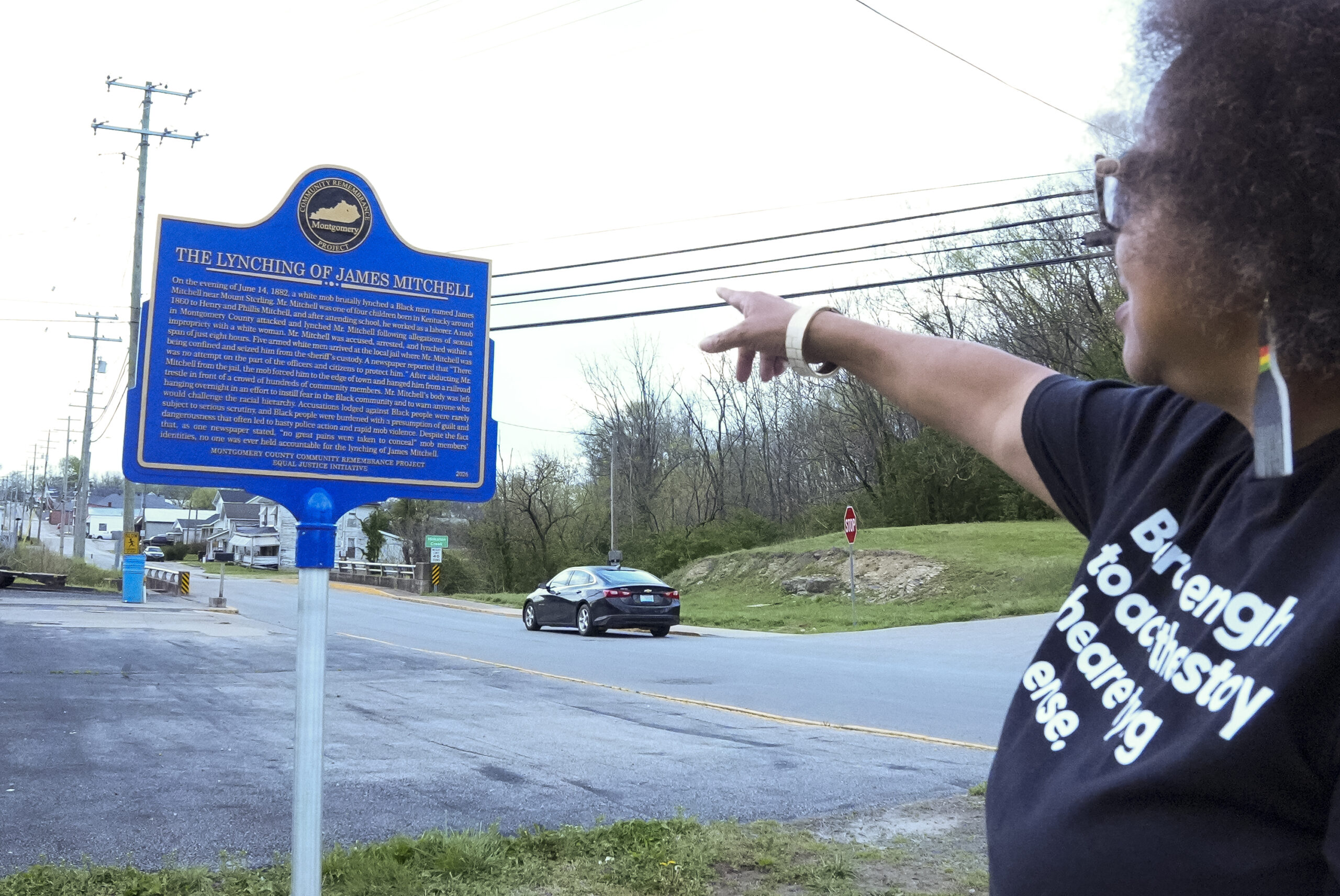
 Valerie Scott, chair of the Community Remembrance Project, points at the newly constructed monument in Mount Sterling, Kentucky, on Thursday, April 2, 2026. Peyton Tindall/The Watchdog
MOUNT STERLING, Ky. – Members of Montgomery County established a historical marker memorializing James Mitchell, a 22-year-old lynching victim, representing the first step toward acknowledging the community’s past.
The marker for Mitchell, one of Mount Sterling’s two known lynching victims, was unveiled on Saturday, March 28, by the Montgomery County Community Remembrance Project.
According to Valerie Scott, chair of the Montgomery County Community Remembrance Project, Mitchell was arrested upon allegations of “sexual impropriety” with a white woman in 1882.
Hours after his arrest, Scott said five armed white men abducted Mitchell from “the old jail” in Montgomery County and hanged him from a railroad trestle.
At the unveiling, community members marched from the site of the old jail to the marker site, chanting, “Say his name: James Mitchell.”
Their march was meant to mirror the assumed path Mitchell walked before he was hanged, according to Scott.
“I didn’t want them to be marching just to be marching, because if you just march, you have no sound to your feet,” Scott said. “But, if you march and know why you’re marching, you make a difference.”
Now, nearly 150 years later, Scott said it is important to teach the next generation of Kentuckians about their community’s past.
She said one day young people will be making decisions about historical markers and local politics, and by keeping them informed, the city is better positioned for the future.
“The white kids are going to be the ones most likely in the leadership roles to make decisions and to change the culture of what we have in the workplace,” Scott said. “They need to know that this [Mitchell’s death] happened.”
After beginning the planning stages in 2023, Scott said it took several years for the project to get its feet off the ground, as the marker faced pushback from people who feared it would portray the city in a negative light.
Many members of the community did not want the marker placed near the old jail or downtown, where Scott said she originally wanted it.
“They felt that the white kids will be paying for the sins of their forefathers. They want to keep this [Mitchell’s death] under the table,” Scott said. “They said, ‘It happened a long time ago, why are we even talking about it?’”
The owner and pastor of Evergreen Baptist Church was the only person willing to sign off on the marker being on their property, allowing them to order the marker.
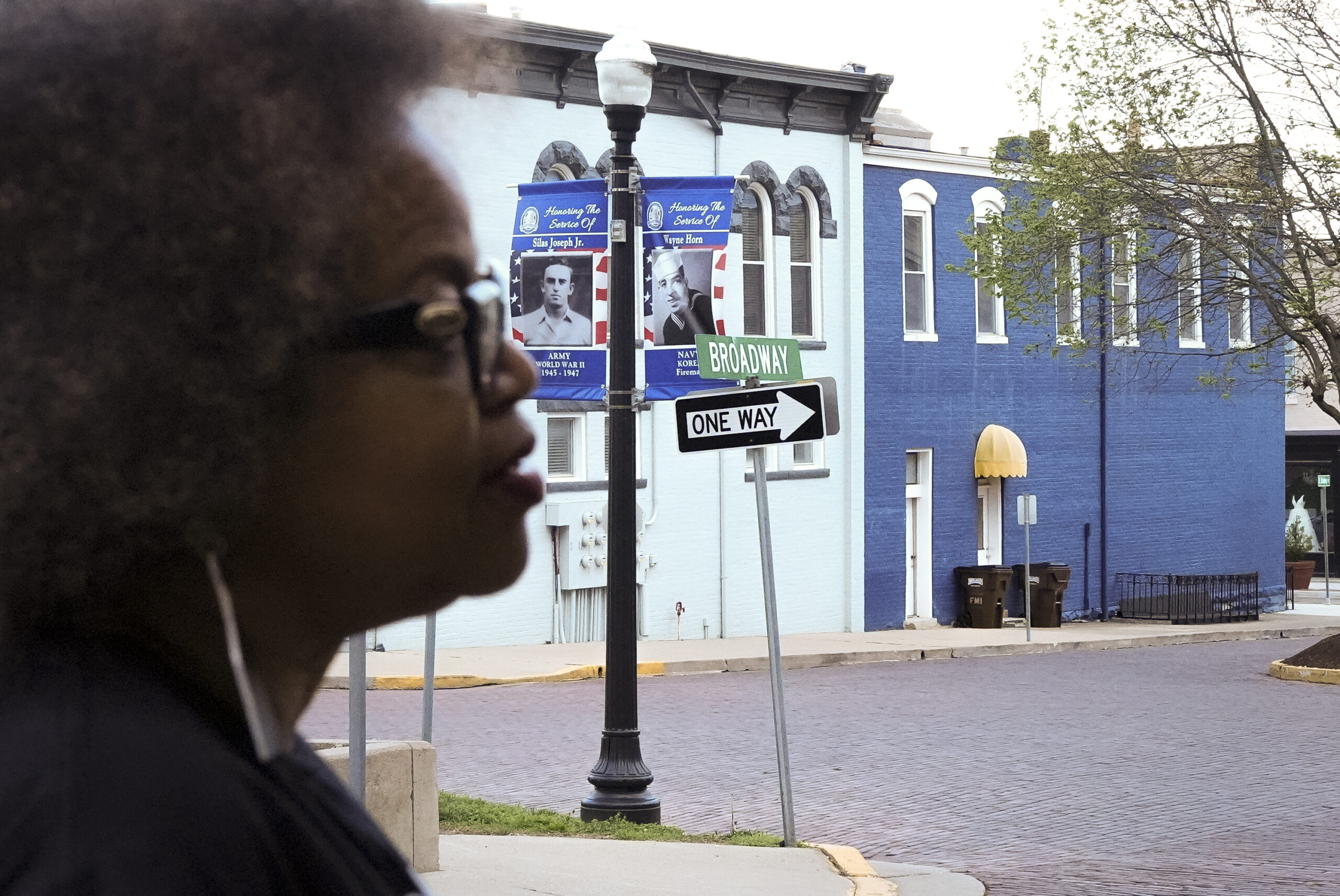 Valerie Scott, chair of the Community Remembrance Project, looks out at the old jailhouse in downtown Mount Sterling, Kentucky, on Thursday, April 2, 2026. Peyton Tindall/The Watchdog
Vicki Wells Cox, a retired genealogist, said she got involved with the project after learning Mitchell’s story after a friend asked her to research it.
“He deserved a trial. We all deserve a trial. If he had been found guilty, then they could have executed him legally, but what they did was just wrong,” Cox said. “So, I thought it was important that the story be told.”
Cox said she believes many members of the community have a “misconnection” about what the marker is about, thinking it blames the city for its past.
“I think the ones who have been negative about it, just really are ill-informed or are stuck in the past and think that anyone who says something different than what they currently believe is just trying to be divisive,” Cox said. “That is not what this is about. It’s [about] trying to get the truth out in a time when truth is really hard to be found.”
Cox said she was proud of not only the attendance at the unveiling, which drew over 50 people, but also of the crowd’s diversity.
As the community still sees a lot of “bitterness and hate” in Montgomery County, Cox said she hopes people will see the marker and finally embrace moving forward.
“The first step to change is acknowledging that something needs to be changed,” Cox said. “That’s why everybody needs to hear these stories.”
Now that the marker has been unveiled, Cox said she and Scott are not yet done fighting.
The Montgomery County Community Remembrance Project is working toward creating a second marker for a lynching victim who was allegedly killed around 1870, after fighting in the Civil War. Scott said the man is currently buried in Montgomery County.
“They thought the story was over, but the story ain’t over,” Scott said. “We’re getting ready to change the narrative.”
Leave a Reply